Recent storms have demonstrated the impact of extreme weather on power systems. In 2019, Hurricane Dorian inflicted more than US$130 million in damages to The Bahamas’ power infrastructure, while Hurricane Beryl in 2024 caused widespread power outages that affected nearly half a million people in Jamaica.
Upgrading Caribbean power systems could generate net benefits of US$4.3 billion across the Caribbean over the next two decades, mainly by reducing the cost of recovering from extreme weather events, according to estimates by the Inter-American Development Bank (IDB). But the lack of funding and limited access to technology and technical expertise often leave these investments beyond the reach of Caribbean countries.
That’s why the IDB, through its ONE Caribbean and Regional Public Goods Initiatives, has partnered with the United Kingdom’s Sustainable Infrastructure Programme (UKSIP) on a three-year technical cooperation programme to strengthen energy systems across seven Caribbean nations: Barbados, Belize, Guyana, Jamaica, Suriname, The Bahamas, and Trinidad and Tobago. The programme will help improve utilities’ disaster response capacity, strengthen regional energy integration, and support the development of financial instruments to speed up post-storm recovery – helping make power outages less frequent and keeping critical services running when they are most needed.
Strengthening Disaster Preparedness in the Energy Sector
The IDB’s partnership with UKSIP aims to mitigate the impact of extreme weather on power systems through a collaborative approach that brings together institutions across the Caribbean region to enhance energy systems, making them stronger, smarter, and more resilient to disasters. It is built on three pillars:
- Disaster response: Working in coordination with the Caribbean Electric Utility Services Corporation (CARILEC), the program will help utilities prepare for emergencies by improving their response plans, establishing protocols for service restoration after a natural disaster, building stronger and more reliable renewable energy systems, and offering training to strengthen the skills of key energy professionals across the region.
- In partnership with the CARICOM Regional Organization for Standards and Quality (CROSQ), the program will also advance the harmonization of energy standards. The first phase will focus on accelerating the adoption of regional energy efficiency building codes and minimum performance standards for lighting and cooling, with future efforts expanding to battery storage, electric vehicles, charging systems, and grid codes to improve safety, interoperability, and regional integration. This kind of alignment strengthens energy security by promoting renewable and efficient technologies. It facilitates coordinated emergency responses, enabling utilities to restore power more quickly and access compatible equipment, especially during times of crisis.
- Financial Risk Management: Another crucial element of the program is helping utilities better manage financial risks. In collaboration with the Caribbean Catastrophe Risk Insurance Facility (CCRIF-SPC), the initiative is exploring the development of tailored risk models for regional utilities as well as new insurance instruments for renewable energy facilities.

The IDB participated in the 2025 Engineering & Procurement Conference & Exhibition’s panel entitled Shaping the Future: Flexible. Resilient. Innovative.
Synergies with the broader Caribbean
As part of a broader commitment to supporting resilience in the Caribbean, the IDB Group has also deepened its cooperation with the Caribbean Development Bank (CDB) by partnering on investments in resilient physical infrastructure, improved project preparation for climate-smart initiatives, and the development of financial tools that give countries greater fiscal flexibility after climate shocks. Aligned with CDB’s Accelerated Sustainable Energy and Resilience Transition – 2030 (ASERT‑2030) programme, this partnership fosters strategic alignment with non-IDB member countries in the Caribbean while strengthening regional capacity to withstand and adapt to escalating climate risks.
Additionally, members of the Organization of Eastern Caribbean States (OECS), namely Grenada, Saint Kitts and Nevis, Saint Lucia, and Saint Vincent and the Grenadines, will similarly be supported through the Strengthening Power Sector Resilience in Caribbean Island States project. Conceptually developed with the support of IDB, this initiative will be implemented by CARILEC and is funded under the second cohort of the Infrastructure for Resilient Island States (IRIS) programme. This project aims to support technical compatibility, coordination, and cooperation mechanisms among regional utilities, while also enhancing CARILEC’s Disaster Assistance Programme (CDAP) framework.
Securing Energy Resilience for Generations to Come
Strengthening energy resilience across the Caribbean is not only essential for safeguarding the well-being and economic stability of its people but also for securing a sustainable future for the region. Through strategic investments and strengthened regional collaboration, the devastating impacts of natural disasters can be significantly reduced. Improved energy infrastructure will minimize outages and enable faster recovery, ensuring that critical services remain reliable when communities need them most. These collective efforts lay the foundation for a Caribbean that is better prepared to face climate challenges, fostering long-term prosperity and security for all its citizens.
Acknowledgments
We would like to express our sincere appreciation to those who contributed to the development of this post. Special thanks to Henry Wisbey-Broom and Charles Laidlaw from UKFCDO for their constructive feedback. We are also grateful to our colleagues Nayeli Mayorga Acosta, Gabriela Montes De Oca Fehr, Remi Rijs, Heather Bernard, and Sheries Ruddock for their continued support and engagement. Their input has been invaluable in shaping and refining our work.
]]>To turn this potential into sustainable development, it is essential to have a transparent and responsible mining sector that builds trust, attracts long-term investment, and promotes fairer and more equitable growth. This not only ensures the social license to operate but also maximizes the positive impact of mineral resources on the region’s economic and social development—an agenda that the Inter-American Development Bank (IDB) has supported in the region for decades.
The Value of Transparency for the Mining Industry
Transparency and accountability are fundamental pillars for any industry aspiring to have a lasting and positive impact on society. As highlighted by Edelman’s 2024 Trust Barometer, trust in companies is strongly linked to these two values, and organizations that promote them not only strengthen their brand but also foster stronger collaborations that benefit all stakeholders.
In fact, companies that operate with transparency are 20% more likely to maintain public trust (International Council on Mining and Metals).However, trust is a fragile resource that requires constant care. Perceptions of the extractive industries are deeply tied to an ongoing commitment to dialogue.
The IDB study “The Unwritten License: Social License to Operate in the Extractive Sector in Latin America” highlights how public perceptions and the legitimacy of extractive projects in Andean countries are directly linked to the balance between social expectations, perceived benefits, and companies’ responsible practices.
Transparency is therefore a key component of the social license, as it allows investors, authorities, local communities, and civil society organizations to access more precise and accurate information about corporate performance and practices.
Lessons from Chile’s Experience
Mining is not only an essential driver of Chile’s economy but also a key enabler of sustainable development and social value creation in the country—an agenda the IDB has supported for several decades.
Over the past decade, the mining sector has contributed an average of 10% of employment and 10.5% of GDP, with sustained annual growth of around 3% between 2019 and 2021 (“Chile’s mining and metals investment guide,” EY, 2025). Moreover, mining continues to be the backbone of Chile’s exports, accounting for an average of 58% of the country’s export revenues.
This is complemented by a broadly favorable social perception of the sector. Currently, 83% of Chileans (Brújula Minera Survey, 2024) have a favorable view of mining, far exceeding the global average. This combination of economic contribution and social legitimacy not only strengthens the sector at the national level but also positions Chile as a relevant case study for other countries in Latin America and the Caribbean.
Chile’s experience offers valuable lessons for a region with a strong presence of extractive industries and growing pressure to ensure their social and environmental sustainability. One key lesson is the importance of transparency and accountability within the sector, which not only strengthens its legitimacy with communities and governments but also attracts greater and better-quality investment.
Creating a Dialogue Mechanism for Greater Transparency In Chile, the National Sustainability and Accountability Forum is a good example of a collaborative approach to strengthening sector transparency. Created in 2022, it permanently brings together Anglo American and more than 30 stakeholders—including communities, civil society, and academia—to share information, ensure accountability, and promote mutual learning.
The IDB supports this space through its mining special group, providing specialized technical knowledge and suggesting guidelines for more inclusive and equitable participation. More than evaluating a single company, the Forum seeks to drive sector-wide improvements by exchanging best practices and building a shared vision for more responsible mining.
This effort is part of a broader agenda to support policies for the sustainable development of Chile’s mining sector, to contribute—at scale and with impact—to initiatives that enable the country to manage its mineral resources better and foster inclusive and resilient economic growth.
Additional Measures to Strengthen Transparency
For mining countries in Latin America, strengthening transparency standards can be decisive in reshaping public perceptions of mining: from an activity often associated with conflict to one viewed as a legitimate engine of development.
In contexts where institutional trust is low, adopting open practices, ensuring access to information, and establishing effective participation mechanisms—such as permanent public–community roundtables throughout the project lifecycle—can substantially improve governance and impact in the sector. Likewise, it is key to strengthen Indigenous consultation processes, ensuring that local concerns are timely considered and effectively incorporated into decision-making.
The IDB’s Work in the Mining Sector
At the IDB, we work closely with governments in Latin America and the Caribbean to strengthen mining sector governance and promote transparency. Our approach combines the development of long-term strategic policies—such as Chile’s National Mining Policy 2050, Argentina’s Strategic Plan for Mining Development, and Peru’s Mining Vision 2030—with modern regulatory frameworks and digital tools that improve public management, reduce administrative timelines, and strengthen social and environmental standards.
In addition, we promote territorial development initiatives, capacity building, and productive linkages that channel the benefits of mining activity into social investment, jobs, and local economic diversification. This work is reinforced by strategic partnerships with private actors committed to more responsible, innovative mining aligned with international best practices. All of this shows that transparency in mining has an impact that goes far beyond extraction, promoting sustainable development that benefits diverse communities across Latin America and the Caribbean.
]]>The new database supplements the 2023 World Bank report, “Unfair Advantage: Distortive Subsidies and Their Effects on Global Trade,” which found that subsidies of all types have been rising since 2008. Governments are increasingly turning to subsidies amid rising geopolitical tensions fueled by climate change, national security concerns, and the race to gain an edge in frontier technologies. Yet, even when deployed in pursuit of legitimate goals, subsidies can harm trading partners, fuel tensions, and provoke countermeasures. They can nullify the benefits of global trade and investment by distorting international prices and limiting market access, as in the case of local content requirements, and they can create inefficiencies in global value chains.
The new database identifies government subsidy programs with stated environmental objectives by sector and compares data for 2022 and 2018. It shows that among green subsidies, priorities are evolving toward programs that support innovation related to green technologies and clean energy goals, such as faster adoption of renewable fuels. China and the United States deploy the largest number of subsidy programs, followed by Australia, Canada, and the European Union. All are large trading economies that have the potential to influence global markets. Most programs are offered by sub-central governments, such as states and provinces.
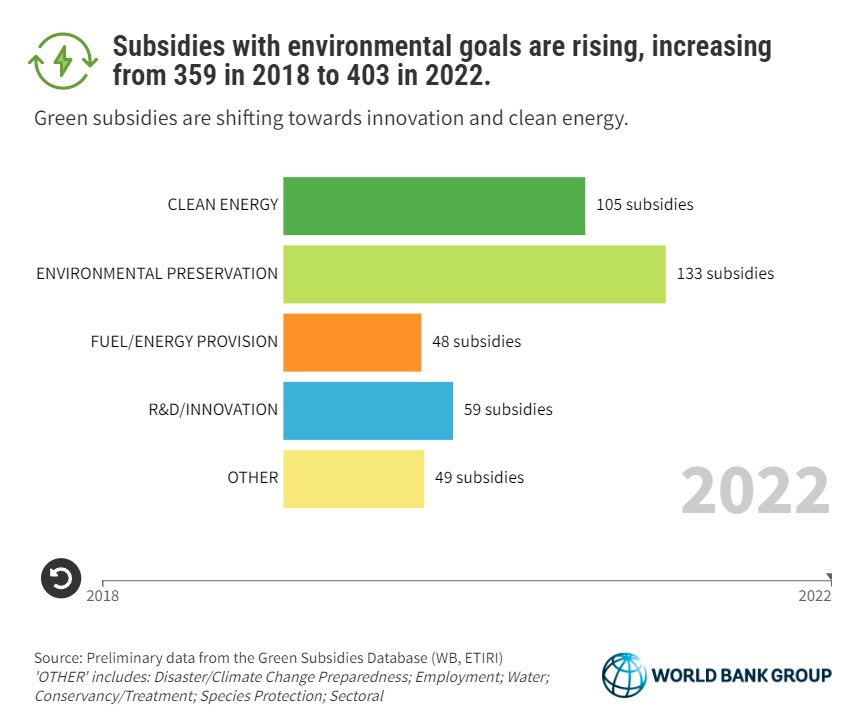
Ambitious climate objectives, market failures, and existing incentives that favor fossil fuel use can justify greater use of green subsidies. Yet there is a risk that some types of subsidies could distort trade or have effects that limit the free flows of goods, services, and technologies that are needed not only to fight climate change but also to reduce poverty.
The World Bank will continue to track these measures as it seeks to increase transparency, deepen analysis on their nature and economic effects, and foster informed discussions among countries on the appropriate use and design of government subsidies.
]]>The report calls for action from stakeholders across the electronics value chain. It encourages the introduction of circular practices and highlights trends that are likely to form a pathway towards 2035. The report underscores the importance of rethinking design, usage and recycling of electronics – beyond traditional e-waste management.
“The report introduces eight trends that we believe are crucial to be aware of and work with when looking at the future of circular electronics. These are broad trends that involve different parts of society, such as tech, regulation, and consumer habits,” says Olivier Rostang, Futures Strategist at Kairos Future, which produced the report.
The report offers a comprehensive overview of various developments poised to influence circular electronics by 2035. It identifies the following eight key trends to look out for:
- Sustainability merges with geopolitics
- The EU as a regulator is growing more important
- Tracking, tracing and transparency on the rise
- Despite setbacks, the circular economy is advancing
- Everything is becoming electronics
- Ownership is getting serious competition
- AI will help speed up the transition
- Consumers demand sustainable comfort and comfortable sustainability
“With this report, we aim to spotlight the key trends that will shape the future of circular electronics. Our goal is to push the conversation forward and stimulate collective action towards a more sustainable future in electronics,” says Andreas Nobell, Development Manager at TCO Development, one of the founding members of Circular Electronics Initiative.
The Circular Electronics Initiative is an international network of 31 member organizations, united in their mission to inspire the more sustainable use of electronics. The implications of these macro trends underscore the critical mission of the Initiative and its commitment to promoting a more sustainable electronics ecosystem.
You can download the full report here.
If you want more information, or if you are a journalist looking to get in touch with experts on circularity and IT products, please contact the Circular Electronics Initiative through Dennis Svärd at dennis.svard@circularelectronicsinitiative.com, or on +46 70 480 40 94.
About Circular Electronics Initiative
Circular Electronics Initiative is an international network with 31 member organizations. Its purpose is to inspire decision-makers, businesses, and consumers to use and manage electronics in a more circular way.
The initiative drives communication activities, including Circular Electronics Day (#circularelectronicsday), which is highlighted every year on 24 January. You can find more information about the initiative and member organizations on the Circular Electronics Initiative website.
]]>While market growth will likely be important for industrialized economies, clean hydrogen represents a major sustainable growth opportunity for developing countries, which, with targeted and significant investment, could account for nearly 70% of the US$1.4 trillion market in 2050 while supporting up to 2 million jobs globally per year between 2030 and 2050.
The projections come from Deloitte’s Hydrogen Pathway Explorer (HyPE) model, which delivers one of the most comprehensive analyses of the supply of hydrogen globally. This research shows that clean hydrogen can deliver up to 85 gigatons in reductions to cumulative CO2 emissions by 2050, more than twice global CO2 emissions in 2021. Deloitte’s outlook provides extensive detail into the cost, production, and market of hydrogen, even analyzing the business challenges facing the successful implementation of clean hydrogen, and providing insights into various market dynamics, such as optimal infrastructure sizing, investment needs, and technology choices.
“This analysis reveals a compelling opportunity for private and public leaders to accelerate the green energy transition,” said Joe Ucuzoglu, Deloitte Global CEO. “While wind, solar, and other more traditional forms of renewable power are essential to a net-zero future, Deloitte’s research demonstrates how clean hydrogen can help tackle decarbonization of some of the world’s most emissions intensive and hardest-to-abate sectors, further mitigating the effects of climate change while fueling economic growth, particularly in developing countries.”

Interregional trade is key to helping unlock the full potential of the clean hydrogen market, supported by diversified transport infrastructure. Regions that are currently able to produce cost-competitive hydrogen in quantities that exceed domestic needs are already positioning themselves as future hydrogen exporters—supplying other less-competitive regions and helping to smoothly facilitate the energy transition. Notably, global hydrogen trade is projected to generate more than US$280 billion in annual export revenues by 2050, with North Africa expected to benefit the most (US$110 billion per year) due to its high export potential.
“If policymakers and business leaders provide decisive support of the market, green hydrogen can outcompete carbon-intensive hydrogen production in less than 10 years,” said Jennifer Steinmann, Deloitte Global Sustainability & Climate practice leader. “Reducing our carbon emissions and the physical and economic damages from unmitigated climate change is a massive win for nations and businesses alike. This represents a key pathway for the world’s developing countries to establish their energy security and independence, bolster economic growth as a result of the investment that will need to flow, and collectively firm up global growth and resilience.”
According to the report, major supply chain investment will be needed to help optimize the global value of clean hydrogen. The report estimates more than US$9 trillion of cumulative investments are required in the global clean hydrogen supply chain to help meet net-zero compliance by 2050, including US$3.1 trillion in developing economies.
“Money is not the problem—though the average annual investment over the time period is significantly less than the US$417 billion that was spent on oil and gas production in 2022 globally,” said Prof. Dr. Bernhard Lorentz, founding chair of the DCSP and Deloitte Global Consulting Sustainability & Climate Strategy leader. “It’s just a question of redirecting the investment to clean energy sources, and Deloitte sees that the global finance industry has an increasing appetite for major investments.”
To help achieve climate neutrality by the middle of the century, the Deloitte outlook shows clean hydrogen supply growing to approximately 600 MtH2eq in 2050. However, based on current clean hydrogen project announcements, the global community could only provide a collective production capacity to meet one quarter of the projected demand in 2030.
To help scale up a robust and fair clean hydrogen economy to meet projected demand, the report recommends policymakers focus attention on three key components:
- Lay the market foundation. Lay out national and regional strategies to lend credibility to the market, develop a robust and shared certification process for clean hydrogen to help ensure transparency, and coordinate internationally to help mitigate political friction and promote a level playing field
- Spur action. Establish clear targets and/or markets for clean hydrogen-based products and offer pointed instruments, such as fiscal incentives and subsidies, to help reduce the cost difference between clean and fossil-based technologies and help businesses integrate clean hydrogen into their value chains
- Ensure long-term resilience. Diversify value chains—from trade partners to raw material suppliers—to help prevent costly bottlenecks during the transition to clean hydrogen, focusing specifically on improving infrastructure design to more effectively transport (pipelines and marine roads) and store (strategic reserves) clean hydrogen commodities
The Deloitte Global Hydrogen Center of Excellence:
To help policymakers and business leaders plan and execute a future built on clean hydrogen, Deloitte has unveiled its Global Hydrogen Center of Excellence. The center is dedicated to supporting clients in scaling up clean hydrogen and driving large-scale decarbonization. Through practitioners at Deloitte firms, the center plans to work with clients across all stages of market development—from advising and sharing insights to help address some of the most complex questions, to implementing solutions and supporting the execution of projects on the ground, to helping enable operations, such as resilient supply chains and infrastructure.
“Scaling up Deloitte’s hydrogen-related offerings to organizations around the world through the Center of Excellence is our latest effort to further support clients during this crucial energy transition and reflects Deloitte’s investment in and commitment to sustainability and climate,” said Tarek Helmi, Deloitte Global hydrogen leader. “Deloitte’s research demonstrates the growth potential of the global hydrogen market—and Deloitte is committed to helping organizations transform their operations through a currently underutilized but effective resource.”
The Deloitte Hydrogen Investment Corridor:
Deloitte has launched a Hydrogen Investment Corridor initiative to help establish multilateral collaboration across key hydrogen trade and investment pathways, with an initial focus on Germany, Australia, Africa, and Japan. As a global platform, the corridor will convene specialists from the public sector, industry, and finance to help accelerate investment in clean hydrogen value chains and help enable the ramp-up of this emerging industry. Through the corridor initiative, Deloitte will support the development of public policy, including hydrogen strategies for public authorities; bring economic and technical modeling skills to help inform decision-making; and convene different entities along the value chain to help support consortia formation and scaled investment.
For more information and to view the full findings of Deloitte’s “Green hydrogen: Energizing the path to net zero” outlook report, visit: www.deloitte.com/global/en/issues/climate/green-hydrogen.html
About Deloitte
“Deloitte,” “us,” “we” and “our” refer to one or more of Deloitte Touche Tohmatsu Limited (“DTTL”), its global network of member firms, and their related entities (collectively, the “Deloitte organization”). DTTL (also referred to as “Deloitte Global”) and each of its member firms and related entities are legally separate and independent entities, which cannot obligate or bind each other in respect of third parties. DTTL and each DTTL member firm and related entity is liable only for its own acts and omissions, and not those of each other. DTTL does not provide services to clients. Please see www.deloitte.com/about to learn more.
]]>Sustainable Energy: An Urgent Need for Change
As the Caribbean grapples with the adverse impacts of natural disasters and the escalating costs of imported oil, the call for sustainable energy solutions grows louder. The challenges faced by the region demand immediate action to ensure energy resilience and affordability. This is where you, as a partner and advocate for change, come in.
Over the years, significant strides have been made in the Caribbean’s pursuit of sustainable energy solutions. Solar panels adorning rooftops, efficient streetlights illuminating the night, and the introduction of electric cars and buses have showcased the region’s commitment to a greener future. The efforts have not stopped there, as evident from the electrification of previously underserved villages. However, despite these achievements, there is still much ground to cover.
The vision of a sustainable energy in the Caribbean requires collaboration and investment. The Inter-American Development Bank (IDB) is committed to support our member countries in the Caribbean and it is crucial to forge partnerships with organizations to driving positive change in the region for sustainable energy. The IDB has already invested US$1.6 billion in renewable energy, efficiency, digitalization, electromobility, resilience, regulation, and rural electrification in the Caribbean. These investments have laid the foundation for progress, and further collaboration is needed to continue the momentum.
Caribbean’s energy landscape must become more resilient and diverse in order to safeguard against the unpredictability of natural disasters and reduce dependence on costly oil imports. Embracing renewable energy sources such as solar, wind, and geothermal power can provide a sustainable alternative. By diversifying the energy mix, the region can reduce vulnerabilities and ensure that everyone has reliable access to electricity, whenever they need it.
A Brighter Future on Sustainable Energy
Now is the time to collectively explore innovative solutions that address the Caribbean’s energy challenges. As we envision a future where every individual can enjoy the benefits of sustainable energy, the need for your involvement and support becomes paramount. Together, we can shape a brighter future, not only for ourselves but for the generations to come.
The journey towards sustainable energy in the Caribbean is underway, but it requires the dedication and collaboration of individuals, organizations, and governments. Through investments, partnerships, and a shared commitment to resilience and diversity, the region can overcome its energy challenges. The time to act is now. It is key to work together towards a future where reliable, affordable, and environmentally friendly energy is a reality for all in the Caribbean in order that we improve the lives of all our citizens in the region and each of us is part of this sustainable transformation on energy and we count with you.
]]>The U.S. Chamber’s Global Energy Institute released a new analysis examining the U.S. Department of Energy (EPA)’s recent rule that aims to reduce carbon dioxide emissions from power plants. Given the essential role that affordable and reliable electricity plays in every aspect of our lives, this rule has the potential to be among the most impactful proposals from the Biden Administration.
The rule will target electricity from coal and natural gas, which today make up about 60% of America’s electricity production. The U.S. Chamber strongly supports a low carbon transition and has been among the biggest supporters of investments in research, development, and deployment for a host of technologies – including renewables and carbon capture and sequestration. We’re also leading an effort to enact permitting reforms that will address extensive delays to building transmission lines and site renewable energy projects.
However, our analysis reveals major flaws in the methodology used by EPA to draft the rule, resulting in inaccurate claims about the costs, benefits and anticipated impacts of the rule.
Specifically, we found:
- Unrealistic claims of massive emissions reductions occurring in the absence of the new rule, which leads to significantly suppressed cost projections.
- Omitting materially increased electricity demand from other EPA rulemakings, which will place greater stress on the power grid.
- Modeling outputs and real-world data that call into question the deployment timelines of carbon capture and sequestration, which is the technology that EPA is relying on as the centerpiece for industry compliance with the rule.
It is our hope that EPA will recognize and address these shortcomings in the rulemaking process. The climate challenge requires transparency from both government and industry, and for all stakeholders to work together in good faith. Our analysis shows that greater transparency from the EPA is necessary here to support the ongoing affordability and reliability of our energy supply.
]]>Volldal emphasizes that the short distance to General Motors, headquartered in Detroit, has played a decisive role in the choice of state. The two companies collaborate to develop further and improve Nel’s PEM electrolyser technology.
“Having Nel’s new facility close to our home base of HYDROTEC development, in southeastern Michigan, will help us more quickly accelerate our electrolyzer collaboration,” says GM executive director of HYDROTEC Charlie Freese.
“We were in the mechanical era 50 years ago, and now we’re in the electrical era, and soon to come we’ll be in the hydrogen era,” said Local 11 Business Director of Renewables Tommy Faave said. “This is the next era of good-paying electrical jobs – whether it’s hydrogen production, storage, or transportation – hydrogen projects like these are going to be key to building up our membership and bringing in more apprentices and more journeymen into Local 11. Fossil fuels are not going to be around forever.”
RTC has awarded New Flyer a five-year contract with an initial firm order for seven zero-emission, hydrogen fuel cell-electric Xcelsior CHARGE FC 60-foot heavy-duty transit buses (or 14 Equivalent Units “EUs”), as well as the option to purchase up to 100 buses (200 EUs) over the duration of the contract. In total, NFI added up to 107 buses (214 EUs) to its first-quarter 2023 backlog from firm and option orders.