Business is facing an unprecedented federal regulatory agenda. With Congress enacting relatively little legislation, the regulatory state is taking on that role. Ideologically driven regulations are cutting across American industry and imposing huge costs on business. And companies are taking notice. The U.S. Chamber recently surveyed a decade of 10-K filings from the S&P 500 and found a large uptick in terms associated with public policy risk, like regulation. These regulatory burdens add up to a systemic threat to free enterprise.
As federal agencies pursue aggressive policy changes through regulation, the Chamber is leveraging its litigation expertise to address these threats.
Your voice is essential, and your participation is critical.
Proliferation of Regulations
Over the next 12 months, the Administration plans to act on some 2,524 regulatory items. Of these, the Administration has 1,075 rules to finalize, with an additional 1,357 in the pipeline, where the next step is proposing a rule or completing public comments. To avoid the possibility that the next Congress and administration could use the Congressional Review Act to block various rules, agencies are rushing to complete actions before mid-summer.

But this regulatory proliferation doesn’t tell the whole story. Historically, agencies have identified proposed rules that they expect to have an economically significant impact of $100 million or more a year. Last year, President Biden adjusted the threshold to $200 million. Even with the higher threshold, the number of economically significant regulations under active consideration today is still 69 percent higher than at the same point in the Obama administration.
This still undercounts the true cost. For example, because of the way regulatory costs are disclosed, none of the SEC’s proposed rules are categorized as having a cost over $200 million, even though some of them far exceed the threshold.

Litigation Strategy
We are responding to this government overreach as a whole-of-Chamber. Our policy teams are submitting comments on agency rules and engaging with agency leadership. And our Litigation Center is taking federal agencies to court, bringing direct legal challenges against regulators for their overreach.
Over the past five years, the Litigation Center has filed lawsuits against 11 federal agencies. Last year, it ended with 24 pending lawsuits and secured an 83 percent win rate in party litigation. With more high-end talent than the appellate groups in most DC law firms, the Chamber Litigation Center is taking on the big cases, the most important for free enterprise, and shaping the law by securing precedent-setting victories in court.
Chamber Litigation by the Numbers
- Over 130 lawsuits have been filed by the Litigation Center since its inception in 1977.
- 83 percent win rate in party litigation last year.
- 32 pending party litigation lawsuits.
- Sued 19 federal agencies in the last decade; and 17 in the last four years.
Top Regulatory Targets
Looking ahead, we expect to make a real dent in the Administration’s regulatory agenda. Bringing lawsuits is one of the most important tools we have to fight the enormous regulatory burdens businesses are facing today. The Chamber and its Litigation Center are committed to challenging a score of rules that pose a significant threat to America’s economic growth and competitiveness.
Here are rules that the Chamber is watching in 2024:
SEC
- Climate Disclosure Rule*
- Human Capital Rule
- Swing Pricing Rule (Open End Fund Rule)
- Custody Rule
FTC
- Noncompete Rule*
- Commercial Surveillance and Data Privacy Rule
- Hart-Scott-Rodino Changes
- Unfair & Deceptive Fees Rule
- Negative Option Rule
CFPB
Fed, OCC, and FDIC
- Community Reinvestment Act Rule*
- Basel III Implementation
Labor Department
- Independent Contractor Rule*
- Overtime Rule
- OSHA Walkaround Rule*
EPA
- Rule Designating PFOA and PFOS as CERCLA Hazardous Substances
- National Ambient Air Quality Standards for Particulate Matter*
- Power-Plant Greenhouse Gas Emissions Rule
- Risk Management Program Rule*
- Vehicle Tailpipe Emissions Rule
FCC
- Digital Discrimination Rule*
- Title II Reclassification Rule
NLRB
Other
- PCAOB Auditing Standard Rule
- FAR Council Federal Contractor Climate Rule
- California Climate Disclosure Laws*
Federal and state regulators should create a regulatory environment that fosters innovation, competition, and growth for businesses, not create burdensome regulations for U.S. businesses. The U.S. Chamber’s top priority is fighting—and winning—for business. We are prepared to challenge government overreach and defend the rule of law.
]]>As the holiday season approaches, the U.S. Chamber of Commerce’s annual Shop Small Campaign is encouraging shoppers to support local businesses on Small Business Saturday on Nov. 25 and throughout the holiday season. Urban Dwell is among the local businesses included in the U.S. Chamber’s Shop Small Guide.
“The fourth quarter is our busiest quarter, about 25% of our business is done during the fourth quarter,” said Tom McMahon, Urban Dwell owner and founder.
McMahon decided to open the boutique gift shop in the trendy Adams Morgan neighborhood after he retired as an intelligence officer from the U.S. Air Force in 2014 with 22 years of active service.
He says at the time he knew nothing about running a business.
But the retired Lieutenant Colonel knew he didn’t want to work in government like many DC-area veterans do. In 2021, the U.S. Bureau of Labor Statistics found that 22.9% of U.S. veterans work in government. For McMahon, working in government did not present the flexibility he needed to be able to care for his 9-month-old daughter and growing family. So, McMahon began looking into opening a business.
Urban Dwell opened its doors in 2015 and has made its mark as a premier gift shop with an array of carefully curated artisan merchandise ranging from kitchen and homewares to children’s toys and trinkets. The shop began with the guidance of McMahon’s sisters-in-law, who each own stores in New York and Philadelphia, and Richard Rose, his mentor at SCORE, a business mentorship program and resource partner for the Small Business Administration (SBA).
Transitioning from Military Service to Business Owner
McMahon’s first introduction to the business world began while he was still an Intelligence Officer for the Air Force. During his active duty, the military organized seminars with the SBA, where McMahon began to learn about entrepreneurship.
After leaving the Air Force, McMahon’s sisters-in-law took him under their wing and taught him the ins and outs of owning a business.
“My wife has two sisters in New York and Philadelphia, and they were like ‘We’ve been doing this for 15 years, we’ll show you how to run this stuff,’” said McMahon.
At first, starting a business was intimidating for McMahon, but with the help of his SCORE mentor and after helping his sisters-in-law at their stores, he quickly realized the skills he acquired on active duty applied to his position as a business owner.
“I was helping Special Forces hunt terrorists around the world and had never worked retail before, so it was a little daunting to think about,” said McMahon. “But then as I got into it more, I realized a lot of the military skills I gained over the years transcended into project management, people skills, leadership, multitasking – all kinds of skills that were able to help me stay organized.”
Urban Dwell’s mission, inspired by McMahon’s travel experiences while on active duty, is to provide gifts for anyone regardless of age or the occasion. The fun and trendy shop offers unique gifts you can’t find anywhere else.

Becoming Part of the Community
The gift shop sits at the corner of 18th Street and Columbia Road in Northwest D.C. When McMahon’s SCORE mentor connected him to a leasing agent who recommended owning a shop in Adams Morgan, he never anticipated the foot traffic his shop would receive. McMahon knew Adams Morgan was popular for its range of bars and restaurants, but he underestimated how quickly his shop would be embraced by the tight-knit community.
“Within two or three weeks, I had at least four to five people walking into the store and saying, ‘We deserve a store like this, we love it,’ and from that moment on, I felt like I was a part of the community,” said McMahon. “They really just embraced us from the beginning, and I never once felt like an outsider.”
Pivoting During the Pandemic
The COVID-19 pandemic presented challenges for small businesses across the country, but the local community continued to keep the store afloat. During the pandemic, Urban Dwell received support from the local community and implemented creative sales techniques to continue to foster relationships with customers. The gift shop created its version of “take-out” by creating a numbered window display of products customers could order.
“The outpour [of support] was amazing,” said McMahon. “We actually made enough to make rent that way, so it was pretty cool.”
McMahon is thankful for the support his shop receives and continues to nurture a relationship with his community by giving back and partnering with businesses and schools in the area.
“I just want to say thank you to the customers who continue to support us,” McMahon said. “I get hit up by developers probably once a month if not more to expand and I have no interest in that because that’s not what shopping small means to me.”
]]>SME Climate Hub is available virtually and free of charge, offering information, training and resources for companies committed to adopting decarbonization processes. Currently, 5,800 companies in more than 120 countries have signed onto the SME Climate Commitment, where they can learn about, measure, reduce and report their greenhouse gas emissions (GHG).
Launched as a pilot in Latin America and the Caribbean, the program has the support of leading companies in different sectors in countries such as Argentina, Chile, Costa Rica and Peru.
“For IDB Invest, it is essential to promote access to tools that allow us to advance toward the goal of achieving zero net carbon emissions. The SME Climate Hub is an excellent platform that supports and recognizes the role of SMEs in achieving an inclusive economy and reducing carbon emissions,” said Milagros Rivas, Division Chief of Advisory Services at IDB Invest.
SMEs represent more than 99.5% of companies in Latin America and the Caribbean and are a key engine for sustainable growth. Measuring carbon dioxide and taking steps to reduce it are crucial actions to optimize emissions management in value chains.
“Small companies are disproportionately affected by the effects of climate change, finding themselves among the least equipped to integrate climate strategies into their businesses,” said María Mendiluce, CEO of We Mean Business Coalition. “Through our partnership with IDB Invest and with the support of Perú Sostenible, We Mean Business Coalition seeks to extend the reach of the SME Climate Hub in Latin America and the Caribbean to help a greater number of SMEs access the tools and resources they need to reduce their emissions and build more resilient businesses.”
SME Climate Hub is an initiative of We Mean Business Coalition, Exponential Roadmap Initiative and the UN Race to Zero campaign, in collaboration with Normative and the Net Zero team of the University of Oxford. The platform already has the support of various organizations such as Ingka Group, IKEA, Meta, Telefónica and 1.5°C Supply Chain Leaders.
About IDB Invest
IDB Invest, a member of the IDB Group, is a multilateral development bank committed to promoting the economic development of its member countries in Latin America and the Caribbean through the private sector. IDB Invest finances sustainable companies and projects to achieve financial results and maximize economic, social, and environmental development in the region. With a portfolio of $15.3 billion in asset management and 375 clients in 25 countries, IDB Invest provides innovative financial solutions and advisory services that meet the needs of its clients in a variety of industries.
About We Mean Business Coalition
We Mean Business Coalition works with the world’s most influential businesses to take action on climate change. The Coalition is a group of seven nonprofit organizations: BSR, CDP, Ceres, Climate Group, CLG Europe, The B Team and WBCSD. Together, we catalyze business and policy action to halve emissions by 2030 and accelerate an inclusive transition to a net-zero economy. Find out more at wemeanbusinesscoalition.org.
About Peru Sostenible
Peru Sostenible is a non-profit that seeks to support companies in their role as agents of change to promote sustainable development in the country. A network of companies, it promotes collaboration among the private sector, the public sector, international cooperation, academia and civil society around the 17 Sustainable Development Goals (SDGs) of the United Nations. Since 2001, it has been the representative of Peru to the World Business Council for Sustainable Development (WBCSD).
]]>
Regarding the billing forecast for the current year 2023, FENEVAL, the National Business Federation for Vehicle Rental with and without driver, has announced that this year they expect to register a billing of close to 1,800 million euros, results that would be equal to practically to those obtained in 2019, before the Coronavirus pandemic.
This would mean a growth of 12.5% compared to 2021, when an approximate turnover of 1,600 million euros was recorded. Lack of supply of vehicles Regarding the situation of lack of fleet that the automotive sector is experiencing as a result of the semiconductor crisis, the president of FENEVAL, Juan Luis Barahona, has assured that they do not expect the situation to improve this year in a notable way and has once again asked car brands that, “given the forecast of record numbers of tourists that the Ministry of Industry, Commerce and Tourism transfers for this 2023, they maintain 20% of the total sales of New Vehicles (VN) to the RAC to be able to continue meeting the demand”.
It should be remembered, in relation to this, that the rental companies went from having more than 800,000 vehicles in circulation in high season in 2019, to only around 600,000 last summer, therefore, from the national employers’ association of the rental companies, it becomes to recommend citizens to reserve their vehicle in advance for the Easter holidays.
Challenges for the RAC in 2023
In addition to the already mentioned microchip crisis, which is affecting the entire automotive sector in general, FENEVAL fears that in 2023 some of the challenges, such as the macroeconomic uncertainty, could jeopardize the favorable tourist forecasts that are expected for this year.
“Given the slowdown in the world economy, marked by high inflation, we could find ourselves with a less propitious evolution than expected in terms of tourist reservations, especially domestic tourists,” Barahona assured. For this reason, he adds, “it is important to reinforce the attractiveness of Spain as a quality and modern tourist destination, through a more personalized and sustainable service.”
This is the case for some communities, associations, and businesses located in the Brazilian Amazon states (“Amazônia”), which already produce and export 60 forest-compatible products such as black pepper, shelled brazil nuts, fish swim bladders, hearts of palm, cocoa and fresh pineapple.
As explained by the Amazon 2030 Project (Coslovsky, 2021), whose methodology allowed to identify export potential in forest-compatible products as an alternative to promote regenerative and low-carbon development, forest-compatible products come from non-timber forestry extraction, agroforestry systems, tropical fisheries and fish farming, and tropical fruticulture.
This term also indicates that they are fresh or minimally processed, are typical of regions with a humid tropical climate, and can be produced in a climate and nature-positive way without harming the environment, generating deforestation, or expanding the agricultural frontier.
The IDB’s Trade and Integration Sector, with the support of Professor Salo Coslovsky, did further research to discover opportunities within Brazilian states.
Room for growth
The region has already begun to make some progress. Between 2017-2019, the export of the aforementioned 60 forest-friendly products generated US$ 295 million per year for Amazônia. It may seem like a significant number, but the opportunity is far greater: those same products generate US$ 160 billion a year in exports worldwide.
The market share of the Amazon region is small relative to the world’s production, not only on average across the entire basket of forest-friendly products but in practically all the individual products, ranging from 7% in the black pepper market to 0.01% in the cocoa market and 0.002% in the fresh pineapples market.
The only exception is in the Brazil nuts in shell market, where Amazônia has a 50% share. However, a more detailed analysis reveals that its firms dominate the least significant and sophisticated step of a larger value chain.
The role of Brazilian states
The recent analysis shows that the ability to export varies considerably between different Brazilian states from Amazônia. Businesses based in the state of Pará, for example, generate US$ 256 million per year by exporting 43 of the 60 forest-friendly products to 89 different countries. The state of Rondonia, on the other hand, obtains only US$ 3 million by exporting 11 products. This heterogeneity suggests that each state faces different challenges in expanding its exports.
Pará, for instance, must retain or expand its lead. Rondonia, on the other hand, must build its capabilities almost from scratch along all margins. In other cases, the difference between states is more subtle but no less significant. For example, both the states of Amapá and Amazonas export their products to relatively high-income countries. Still, Amapá exports large volumes of few products to few destinations (mostly açaí puree to the U.S).
For this reason, its main challenge is to diversify its portfolio and reach more countries without compromising on quality.
On the other hand, Amazonas exports smaller volumes of many different products to a large number of countries. Its challenge is to export larger volumes of the products it already exports.
Comparison of exports by State
Forest-Compatible Products
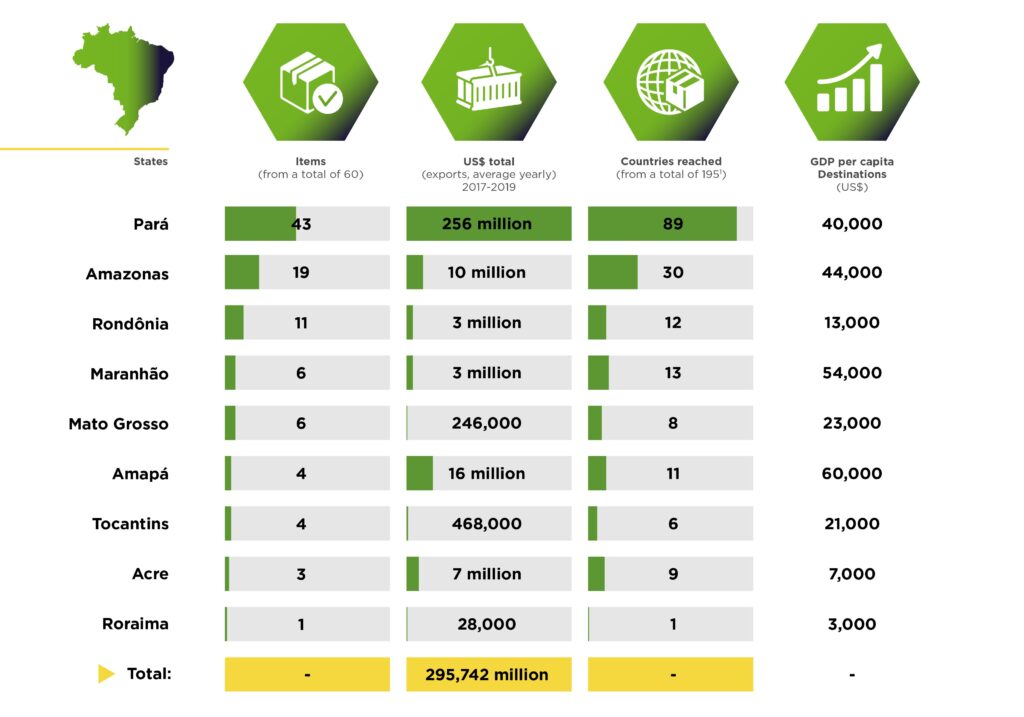
By analyzing the products exported by each state, we also identified a significant degree of territorial specialization. It is reasonable to assume that part of this specialization results from geographical and ecological differences between states. But an important part of this specialization is likely caused by barriers to disseminate skills and knowledge across states, and other aspects linked to market access.
Unlocking the export potential
The recent analysis shows that Amazônia already knows how to produce forest-friendly products with enough proficiency to compete successfully in the global market. It also confirms that this region is only scratching the surface of its potential, with substantial differences and disparities among states.
To unlock the potential, further analysis of the territory’s root causes is critical. This can be associated, for example, with low levels of capacity building (like education and skills), high costs associated with accessing markets (like broadband, electricity, transport, and logistics), low availability of export-related services (like training, verification/certification, packaging, and labels), and informality.
However, many of the production factors needed are already available in the region itself. The challenge is to mobilize them efficiently while maintaining environmental sustainability.
In conclusion, the sustainable promotion of forest-compatible products could help drive environmental sustainability. It could also provide better standards of living for small producers and local populations of a diverse region composed of more than 35 million inhabitants.
]]>“Airline retailing means putting the customer at the center of the air travel shopping/ordering/paying ecosystem. We are excited to see Sabre’s strong alignment with this vision as a Recognized Systems Provider in the ARM Index,” said Yanik Hoyles, IATA Director of Distribution.
Designed to assess the maturity of industry players in the journey to airline retail, the ARM Index replaces the previous IATA New Distribution Capability (NDC) and ONE Order certifications, and extends the scope of the program beyond the standards. technicians to recognize the benefits of value chain collaboration and value creation. Introduced in November 2021, the program is based on three pillars: Capability Check to measure technical skills to buy, order, pay, settle, post and set up; Implementing partnerships to determine the scalability of NDC-enabled offerings across the value chain; and Value Capture Compass to track potential value captured throughout the sales transformation journey.
“We are very proud of Sabre’s inclusion in the ARM Index and wholeheartedly welcome IATA’s move towards a more layered and multi-faceted view of airline retail,” said Kathy Morgan, vice president of channel delivery, Sabre Travel Solutions. . “From the beginning, we have approached NDC as a technical foundation to offer a more personalized traveler experience. We named our program “Beyond NDC” to signal a focus not only on ticking boxes on a technical capability checklist, but also on a longer-term business view and the value that NDC brings. Sitting at the crossroads of travel, we listen to our customers on both the supply and demand sides of our digital travel marketplace,
Sabre has a busy NDC roadmap set for the remainder of 2022 to continue advancing our capabilities. Dynamic air pricing for NDC offers will be available with the recently launched Air Price IQ product within the Sabre Retail Intelligence suite, which will enable airlines to optimize offers in real time with machine learning and data analytics capabilities market leaders. Support for exchanges will be added to the current cancellation, void and refund capabilities, providing robust service functionality. Radixx, which provides solutions for low-cost airlines, is also expected to be certified under the ARM index later this year as an airline IT provider.
Sabre is in discussions with more than 25 leading airlines about selling their NDC offerings through its digital marketplace. In addition to Singapore Airlines and Qantas, which combined are active in 50 markets and are beginning to roll out their NDC content in North and South America, Sabre is actively involved with Lufthansa Group, Qatar Airways and United Airlines, among many other airlines. These airlines’ NDC offers will be available in the coming months through Sabre’s Offer and Order APIs, the agency’s point of sale, Sabre Red 360, and the online booking tool, GetThere.
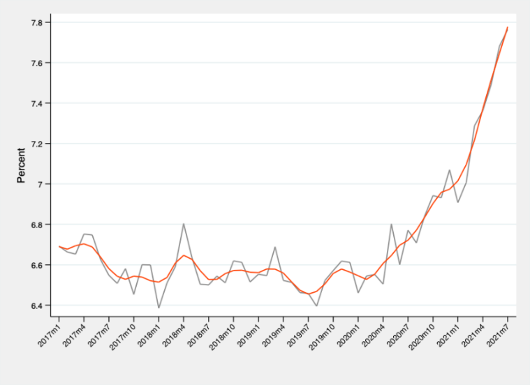
]]>In this blog, we provide some initial insights into the nature and drivers of this trend in transportation costs and discuss some of its implications for Latin America and the Caribbean.
Figure 1: Average ad valorem freight rate of US imports
Shipping costs across products and regions
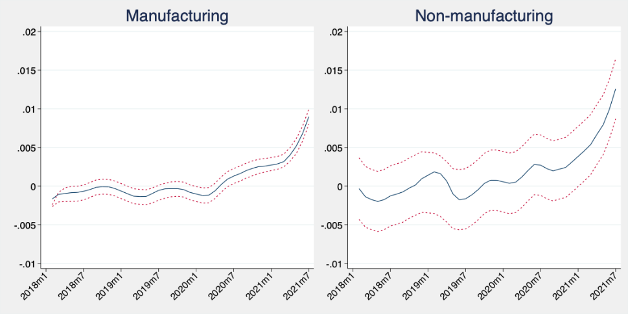
Focusing on US imports from all countries in the world, Figure 2 presents the deviation from “normal levels” of ad valorem freight rates for manufacture and non-manufacture (agricultural and mining) products. [2] A band above zero indicates higher than “normal” shipping rates, given the composition of trade across partner countries and seasonality.[3] The results reveal that the shipment of manufactured goods started to significantly deviate in the second half of 2020. Instead, freight rates for non-manufactured goods showed more heterogeneity over time and only significantly diverged from the benchmark in more recent months.[4]
Figure 2: Ad valorem freight rate of US imports, by sector
(Deviations from normal levels)
A similar exercise based on the origin regions (Figure 3) shows that imports from Asia seem to be driving most of the increase in the freight rates. In particular, shipping costs associated with US imports from Asia trended above normal much earlier. They exhibit much higher levels than their counterparts linked to US imports from Latin America and Europe, which only trended above normal in recent months.
Figure 3: Ad valorem freight rate of US imports, by selected origin regions
(Deviations from normal levels)
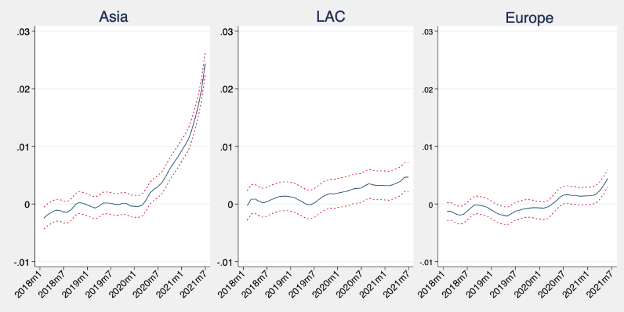
Overall, Figures 2 and 3 provide some indication that Asia’s manufacturing imports are playing a central role behind the recent rise in shipping costs. The next question is why?
Drivers of rising shipping costs
A confluence of forces, mostly related to COVID-19, appears to be behind these trends. On the one hand, the need to implement measures to stop the spread of the virus meant longer processing times at ports, leading to congestion, bottlenecks, and rising costs. In principle, this would have affected imports from all origins, but as shown in Figure 3, the imports from Asia led this charge.
Thus, additional factors should be at play. One of the explanations is a sharp increase in the demand for Asian imports as the result of COVID-related shifts in consumption patterns. Incentivized by the lockdowns, spending shifted away from services, such as movies, restaurants, and gym memberships to physical goods.
This shift in consumption patterns towards manufacturing goods was met largely by Asian imports. For example, during the first seven months of 2021, the imports from Asia were already up by 11.7% compared to a similar period in 2019, while the imports from Latin America and Europe were up by only 2.9% and 2.5%, respectively.[5]
An example that vividly illustrates both the change in consumption patterns and the higher demand for manufactured goods from Asia is the sharp increase in the imports of exercise equipment. Induced by the lockdowns -including gym closures- the demand for exercise cycles, treadmills, rowing machines and other exercise equipment skyrocketed. In the first 7 months of 2021, for example, the total US imports of exercise equipment were up by 167% compared to a similar period in 2019. This sudden increase in demand was met mostly by Asia, as shown in Figure 4 (left panel).[6]
Another example is the increased demand for home appliances, as people spend more time at home. The right panel of Figure 4, for example, shows the increase in demand for vacuum cleaners and similar appliances, which was once again met primarily by Asia.
Figure 4: US imports
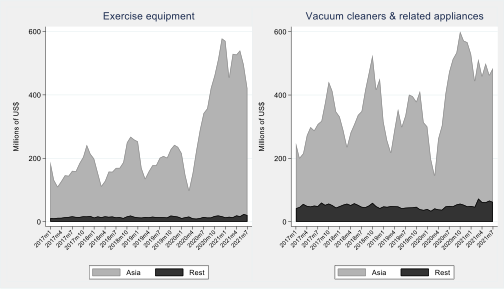
Overall, the COVID-induced surge in demand for manufactured (consumer) goods, primarily met by Asian countries, faced supply-side constraints related to longer processing times, port congestion, and delays, feeding the increase in shipping costs.[7] An additional limitation is that the supply capacity in the shipping industry takes time to react.[8]
A domino effect
The phenomenon described above is becoming more global. A container kept on land for longer than usual cannot be used on new shipments or additional routes. Similarly, ships that embark to serve routes with high shipping fees, deprive other routes of capacity.[9] Figures 2 and 3 already show some signs of this domino effect, as freights associated with Latin America and Europe as well as those associated with non-manufactured goods are rising above normal levels recently.
Looking ahead
Given the nature of the forces involved, it would seem reasonable to expect this shock to be temporary. As the number of vaccinated individuals increases and pandemic restrictions are lifted, consumers should begin to divert their spending back to restaurants, hotels, gym memberships, and other services, easing pressure on imports of goods. Similarly, measures in port operations that prolong processing times should be expected to decrease as the pandemic is brought under control, reducing delays and congestions. But temporary neither means immediately -as current conditions may persist for some time- nor that it cannot have lasting consequences.
In the meantime, more analyses are clearly needed. Current work at the Inter-American Development Bank’s Integration and Trade Sector includes separating shipping costs trends by port location (in the US); delving deeper into the relationship between lockdowns and transportation costs; and estimating the impact of increased shipping rates on trade flows from the region, along both the extensive margin (number of exporting firms) and the intensive margin (average exports per firm) and across different goods categories (e.g., intermediate vs. final), among others. The results of these studies will provide insights that will help countries identify the appropriate policy responses and guide IDB’s operative support to these initiatives.
[1] Red line corresponds to smoothed values.
[2] We refer to normal levels, as the levels that can be explained by historical country and product factors. More technically, the figure reports the coefficient estimates for the variable T in the following regression: Y(cpym)=FE(cp)+FE(m)+Z(jj) x T(ym)+e(cpym); where Y(cpym) is the ad valorem freight rate associated with the US imports from country c, product p, year y and month m; FE(cp) is a fixed effect at the country-product level; FE(m) is a fixed effect at the month level; Z(jj) is an indicator variable for each product category (or origin region category in Figure 3), T(ym) is a fixed effect at the year-month level, and e(cpym) is the error term.
[3] The band represents 95% confidence intervals.
[4] The higher dispersion of non-manufacturing goods’ freight rates is reflected in the broadness of the band depicting their evolution.
[5] Asian imports of consumption goods and capital goods experienced the largest expansions, as they were up by 15.3% and 14.8% in the first seven months of 2021 relative to the same period in 2019.
[6] The share of Asia went from 92% in the first seven months of 2019 to 97% in the first seven months of 2021.
[7] This does not preclude the role of other factors, like rises in the price of fuel and the consequences associated with changes in the structure in the shipping industry over the last decade.
[8] For instance, it can take one year to build a container ship.
[9] More containers are leaving Asia than returning, and excess containers are sitting at ports with no way to “get home”.
]]>“Port Tampa Bay is incredibly grateful for the support of Governor Ron DeSantis. Governor DeSantis and the Florida Department of Transportation realize seaports are economic drivers that impact the regions they serve and the entire state. Our port remained open and ready to serve our community during the COVID-19 pandemic. Port Tampa Bay will use our $20 million allocation to continue to support our strategic priority infrastructure and growth of the port. These funds will have an impact on the more than 85,000 direct and indirect jobs we touch,” explained Paul Anderson, Port Tampa Bay President & CEO.
On March 11, 2021, President Joe Biden signed into law the American Rescue Plan Act to provide economic relief during the COVID-19 pandemic. Port Tampa Bay is appreciative of both Governor Ron DeSantis and Florida Department of Transportation Kevin J. Thibault for recognizing these funds are critically important for the state’s seaports to continue to serve their regions.
Port Tampa Bay is not only Florida’s largest cargo tonnage port, it is also one of the most diversified ports in the country with a wide mix of dry bulk, liquid bulk, break bulk and RoRo cargo in addition to containers, as well as being a major shipbuilding and repair center and cruise home port. In addition, Port Tampa Bay is Central Florida’s largest economic engine contributing more than $18 billion in economic impact.
]]>Edward Gonzalez, Seaboard Marine President and CEO, said, “In keeping with our commitment to efficiency and innovation, we sought to accomplish more than one goal. First, we wanted to improve our customer’s experience by providing enhanced visibility to their cargo. However, we also wanted to improve the speed and efficiency of our warehouse operations significantly through leveraging technology.”
“It’s exciting to be working with the Seaboard Marine team right here in Miami,” said Gary Nemmers, Chief Executive Officer at Magaya. “The Magaya platform is a great fit in supporting warehouse process optimization by saving significant time on repetitive, manual tasks. This will give Seaboard Marine the return on investment needed to continue its growth for many years to come while, more importantly, better serving its customers.”
]]>Digitalization must be driven by the needs of the people and work for them.
As the world has grappled with the COVID-19 pandemic, with closing of borders, curfews, lockdowns and other movement restrictions, digitalization has come to the rescue. Online shopping and entertainment, digital financial services, virtual meetings and events have taken center stage in lives and livelihoods globally.
Digital solutions
Policymakers at the onset of the pandemic took emergency measures to support and facilitate digital activities. The Central Bank of Kenya waived charges and expanded the limit for low-value mobile money transactions. This led to a significant increase in both value and number of transactions, mostly of $10 or less, helping to cushion the most vulnerable households, and attracting more than 1.6 million additional customers. In Rwanda, all charges were waived in March. By the end of April 2020, the weekly value of all kinds of mobile money transactions increased by 450 percent from pre-pandemic levels.
Businesses also moved quickly to leverage the power of digital technology. In China, Ant Group partnered with more than 100 banks to launch the Contactless Loans initiative to help small and medium enterprises recover from COVID-19. In Brazil, the central bank is launching PIX, an instant-payments system expected to become widely available this month. In India, Riskcovry, a Mumbai-based start-up, introduced a coronavirus insurance policy for businesses that want to offer their employees hospitalization and lost-wages coverage.
Fortuitously, for the last 18 months, as part of the United Nations Secretary-General’s Task Force on Digital Financing of the Sustainable Development Goals , we explored how digitalization can help tackle the world’s most urgent development challenges. COVID-19 only amplified its mandate. The pandemic has hindered the implementation of the Sustainable Development Goals, particularly in health and education. Getting back on track will be imperative to achieve a global recovery.
How can digitalization help?
We have three recommendations to share. First, placing people at the center of the global financial system. Digitalization must be driven by the needs of the people and work for them. For instance, Kenya introduced in 2017 a mobile-based digital bond dubbed M‑Akiba to mobilize micro-savings of as little as $30 to finance government. Remarkably, 85 percent of investors were participating in the government securities market for the first time.
Second, connecting citizens to mitigate the digital divide. Over 700 million people lack broadband connectivity, while over a billion lack formal identification. Countries must invest in digital infrastructure and digital identity so their citizens can access online services. Coupled with that, there has to be investment in numeracy and financial literacy. International co-operation will be needed to support these efforts. The International Monetary Fund, World Bank and other international organizations are working with the private and public sectors globally to help countries.
Third, strengthen the governance of global digital financial platforms. The so-called Big Techs are transforming the delivery of services globally including in developing countries. COVID-19 has accelerated this trend as they get more entrenched in everybody’s lives. However, developing countries have not been at the table when the governance of these platforms is discussed. One of the taskforce’s key initiatives is the Dialogue on Global Digital Finance Governance, that seeks to facilitate a balanced and more inclusive dialogue, particularly involving developing nations, on better aligning Big Tech governance to the Sustainable Development Goals.
Down the road
As we build a digital bridge to the future, we must stay focused on the resultant risks. Cybersecurity, and data privacy and security are the greatest threats to vulnerable citizens using digital services for the first time. We must mitigate these risks and protect their information and their hard-earned money.
The pandemic crisis presents the greatest opportunity to enhance the lives and livelihoods of citizens. Governments, the private sector, international organizations and citizens must take up the challenge of increasing digitalization and dare to make a difference.
]]>